
Work-Life Priority Analyzer
Feeling overwhelmed? Enter a task or habit you're currently struggling with, then determine its Urgency and Importance to see how you should handle it.
The Eisenhower Matrix Reference
You wake up at 3 a.m., and before your eyes are even fully open, you're thinking about that email from your boss or the deadline looming on Thursday. You've spent the last three years climbing the ladder, but now you've realized the ladder is leaning against the wrong wall. You're exhausted, irritable, and you can't remember the last time you enjoyed a hobby without feeling guilty that you aren't working. This isn't just 'being busy'-it's the feeling of your personal life being swallowed by your professional obligations.
Restoring your work-life balance isn't about a perfect 50/50 split of your hours. That's a myth that only leads to more stress. It's actually about creating a sustainable rhythm where you can excel at your job without sacrificing your sanity or your relationships. If you feel like you've lost the plot, the good news is that you can claw your time back, but it requires a shift in how you view your availability.
Quick Wins for Immediate Relief
- The Hard Stop: Pick a time-say 6:00 p.m.-and shut down every work device. No "just one more check."
- Digital Distance: Move your work email app off your home screen so you don't see notifications by accident.
- Micro-Breaks: Use the Pomodoro technique (25 minutes of work, 5 minutes of stretching) to break the trance of deep focus.
The Psychology of Burnout and Why You're Stuck
Before you can fix the balance, you have to understand why it broke. Most people fall into the trap of Burnout, which is more than just fatigue. According to the World Health Organization, burnout is a syndrome resulting from chronic workplace stress that hasn't been successfully managed. It usually manifests in three ways: feelings of energy depletion, increased mental distance from your job, and reduced professional efficacy.
Many of us suffer from "performance anxiety," where we believe that being the most available person in the room equals being the most valuable. This is a dangerous lie. When you work 12-hour days, your quality of output actually drops. Research into cognitive load shows that after a certain point, your brain stops processing information effectively, leading to more mistakes and slower decision-making. By trying to do more, you're actually doing worse.
Setting Boundaries That Actually Stick
Boundaries are the fences that protect your peace. The problem is that most people set "soft boundaries"-they say they'll stop working at 6 p.m., but then they answer a "quick question" on Slack at 8 p.m. A soft boundary is just a suggestion; a hard boundary is a rule.
To implement hard boundaries, you need to manage expectations. If you've been the person who replies to emails at midnight for two years, people expect that. When you suddenly stop, they'll notice. The trick is to communicate the change proactively. Tell your team: "I'm focusing on increasing my productivity during core hours, so I'll be offline from 6 p.m. to 8 a.m. to recharge. If there's an actual emergency, please call me, otherwise, I'll handle everything first thing in the morning."
Interestingly, when you set these limits, people usually respect them. In fact, they often start respecting your time more because you've demonstrated that your time has value. If you treat your time as an infinite resource, others will treat it like one too.
Mastering Time Audits and Prioritization
You can't manage what you don't measure. For one week, track every single thing you do in 30-minute increments. You'll likely find that "work" isn't just the tasks you're paid for; it's the endless meetings that could have been emails and the "quick syncs" that eat up your entire afternoon. This is where Time Blocking becomes a lifesaver. Instead of a to-do list, which is just a wish list of things you hope to do, use a calendar.
Assign specific blocks of time for deep work, shallow work (emails, admin), and personal life. If "Gym Time" or "Reading Hour" is on the calendar, treat it with the same urgency as a client presentation. If a colleague asks for a meeting during your blocked-off personal time, don't say "I can't." Instead, say "I'm unavailable then, but I have an opening at 10 a.m. tomorrow." This shifts the conversation from your availability to your schedule.
| Urgency / Importance | High Importance | Low Importance |
|---|---|---|
| High Urgency | Do Now: Crisis, deadlines, urgent client requests. | Delegate: Reports, some emails, scheduling tasks. |
| Low Urgency | Schedule: Planning, relationship building, exercise. | Eliminate: Mindless scrolling, excessive meetings, busy work. |

Reclaiming Your Identity Outside of Work
One of the biggest reasons we struggle with balance is that our identity becomes fused with our job title. When you are "The Marketing Director" 24/7, any gap in your schedule feels like a void that needs to be filled with more work. To restore balance, you need to cultivate Hobbies that have absolutely nothing to do with your professional success.
Pick something where you are allowed to be bad at it. Whether it's pottery, Brazilian Jiu-Jitsu, or learning to bake sourdough, the goal is to engage in a flow state-a mental state where you're fully immersed in an activity for its own sake. This acts as a cognitive reset. When you have a rich personal life, work becomes a part of your life rather than the center of it. You stop seeking validation solely from your manager and start finding it in your own growth and connections.
Managing the Guilt of Not Working
The hardest part of restoring balance isn't the scheduling; it's the guilt. You'll feel like you're failing your team or falling behind. This is often linked to a concept called Toxic Productivity-the internal drive to be productive at all times, even when it's detrimental to your health. You have to reframe how you view rest. Rest is not a reward for hard work; it is a requirement for hard work.
Think of your brain like a smartphone battery. You wouldn't expect your phone to run for a week without a charger, so why do you expect your brain to function at 100% without downtime? When you take a weekend off, you aren't "slacking"; you're charging. The most productive people in the world aren't the ones who work the most hours; they are the ones who recover the most effectively.
Dealing with Toxic Work Cultures
Sometimes, the problem isn't your time management-it's your environment. If you work in a place where "hustle culture" is praised and taking a vacation is seen as a lack of commitment, no amount of time-blocking will save you. In these cases, you have to decide if the cost of the job is worth the price of your health.
Start by observing the leadership. Do they actually take vacations? Do they send emails on Sundays? If the culture is fundamentally broken, your primary goal should be an exit strategy. It's much easier to find a new job while you still have some energy left than to wait until you've completely crashed and burned. Look for companies that explicitly mention "flexible work' or 'outcome-based performance' rather than 'face-time' in their culture descriptions.
Sustainable Habits for Long-Term Balance
Balance is a verb, not a noun. It's something you do every day, not something you achieve once and keep forever. Some weeks will be heavy-maybe there's a product launch or a quarterly review. That's fine, provided you balance the scales afterward. If you work 60 hours one week, make sure you work 30 the next. This is called "periodization," a concept borrowed from athletic training to prevent injury and maximize performance.
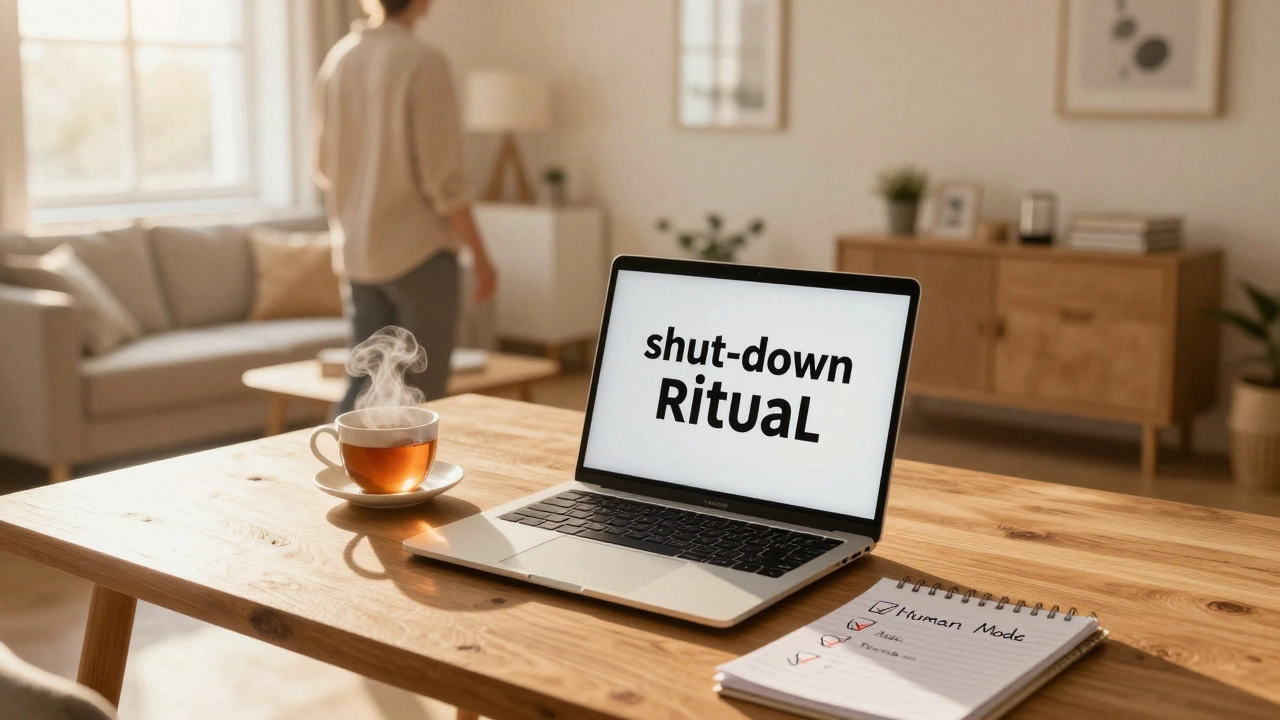
Create a "shut-down ritual." This is a series of small actions that tell your brain work is over. It could be closing all your browser tabs, writing a list of the top three things to do tomorrow, and physically closing your laptop. This ritual acts as a psychological bridge, transitioning you from "Worker Mode" to "Human Mode." Once the ritual is complete, the work day is officially dead.
Frequently Asked Questions
Can I really achieve a perfect 50/50 balance?
No, and trying to do so is often a recipe for more stress. Balance is dynamic. Some weeks your job will need 80% of your energy, and other weeks your family or health will need 80%. The goal is a long-term average that feels sustainable, not a perfect daily split.
What if my boss ignores my boundaries?
If you've communicated your boundaries clearly and they are still being ignored, it's time for a formal conversation. Focus on the impact on your work quality. Instead of saying "I'm stressed," say "I've noticed that replying to emails late at night is reducing my focus during our core hours, and I want to ensure my output remains high quality." If that doesn't work, the issue is the culture, not your boundaries.
How do I stop feeling guilty when I'm not working?
Acknowledge that the guilt is a habit, not a fact. Remind yourself that rest is a professional responsibility. An exhausted employee is a liability; a rested employee is an asset. When the guilt hits, consciously shift your focus to the activity you're doing-be present in the moment.
Is working from home making my balance worse?
Often, yes. When your office is your living room, the physical boundary between work and life disappears. To fix this, create a dedicated workspace-even if it's just a specific chair. When you leave that chair, you've "left the office." Changing your clothes after work can also help signal the transition to your brain.
How do I start this process without overwhelming myself?
Don't try to change everything at once. Start with one "hard boundary," like no emails after 7 p.m. Do that for two weeks. Once that feels normal, add another change, like a scheduled 30-minute walk at lunch. Small, incremental changes are more likely to stick than a total lifestyle overhaul.