
Burnout Risk & Balance Estimator
Step 1: Balance Audit
Check all that apply to your current weekly routine:
Step 2: Time Recovery (80/20 Rule)
Your Balance Snapshot
You wake up at 3 a.m. with your heart racing, thinking about an email you forgot to send or a deadline that's creeping up. You're physically at the dinner table, but mentally, you're still in a spreadsheet. This isn't just 'being busy'-it's the feeling of your personal life being swallowed by your professional obligations. If you feel like you're running on a treadmill that only goes faster, you've likely lost your equilibrium. The good news is that you can get it back, but it requires more than just taking a random Friday off. It takes a systematic redesign of how you spend your energy.
To fix this, we first have to understand that work-life balance is the state of equilibrium where an individual prioritizes the demands of their career and the demands of their personal life equally. It isn't a perfect 50/50 split every single day, but rather a sustainable rhythm over weeks and months. When this balance breaks, you hit Burnout, a state of emotional, physical, and mental exhaustion caused by excessive and prolonged stress.
Quick Wins for Immediate Relief
- The Hard Stop: Pick a time (say, 6:00 PM) and treat it like a flight you cannot miss. Close the laptop and move it to another room.
- Digital Detox Hour: Turn off all notifications for the first hour after you wake up and the last hour before bed.
- Micro-Breaks: Use the Pomodoro technique-work for 25 minutes, then step away from the screen for 5.
Audit Your Energy, Not Just Your Time
Most of us try to fix our balance by looking at a calendar. But time isn't the only resource; energy is. You might have three hours of free time after work, but if you've spent all your mental energy on a difficult project, those three hours are spent staring at a wall or scrolling through social media. This is called 'decision fatigue.'
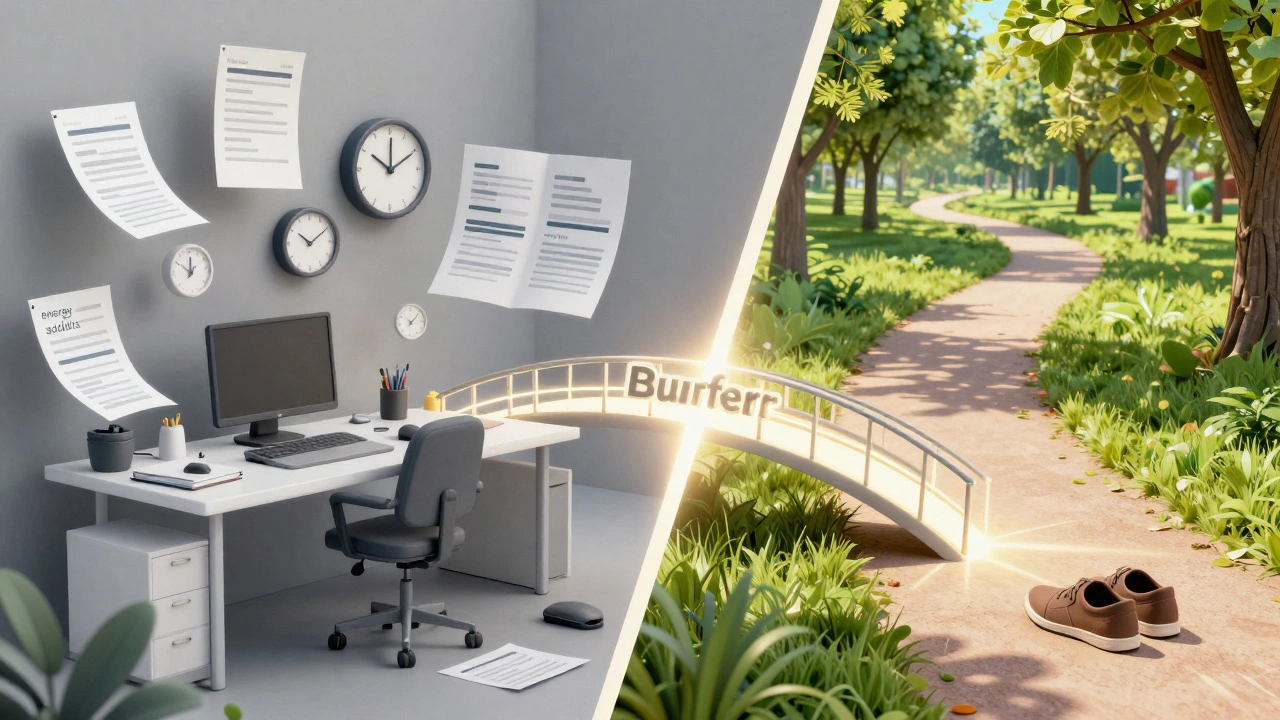
Start by tracking where your energy goes for one week. Notice which tasks leave you feeling drained and which ones actually recharge you. For example, a 15-minute walk in the sun might give you more energy than a two-hour nap. If your job requires high-intensity cognitive labor, you can't expect to come home and immediately tackle a complex home renovation project. You need 'buffer activities'-low-stakes transitions like listening to a podcast or showering-to shift your brain from 'work mode' to 'home mode.'
Setting Boundaries That Actually Stick
Boundaries aren't walls; they're gates. You decide who comes in and when. The problem is that many of us set boundaries in our heads but never communicate them to our colleagues. If you respond to a Slack message at 9 p.m. on a Tuesday, you've just taught your boss that you're available at 9 p.m. on Tuesdays.
To restore work-life balance, you need to implement clear, communicated boundaries. Instead of saying "I'm too busy," try "I can get this to you by Thursday morning, as I'm focusing on the quarterly report today." This manages expectations without sounding like you're complaining. Use technology to help you. Set your status to 'Away' or 'Do Not Disturb' on Microsoft Teams or Slack. When the notification bell stops ringing, your brain can finally exit the 'fight or flight' state.
| Scenario | The Burnout Approach | The Balanced Approach |
|---|---|---|
| Weekend Emails | Checking inbox every hour | Checking only Monday morning |
| Lunch Break | Eating at the desk while typing | Away from screen for 30 mins |
| Urgent Requests | Dropping everything immediately | Asking for the actual deadline |
| Vacation Time | Checking emails from the beach | Full disconnect with an OOO reply |
The Psychology of 'Good Enough'
Perfectionism is the enemy of balance. If you're spending three hours polishing a slide deck that only needs to be 'clear' rather than 'perfect,' you're stealing time from your family, your sleep, or your hobbies. This is often driven by a fear of failure or a desire for external validation.
Apply the 80/20 rule, also known as the Pareto Principle. This concept suggests that 80% of your results come from 20% of your efforts. Identify the high-impact tasks that actually move the needle and give them your best energy. For the other 80% of tasks-the routine emails, the minor updates-aim for 'competent' rather than 'perfect.' When you stop over-engineering every small task, you suddenly find an extra 5-10 hours a week.
Reclaiming Your Personal Identity
When work consumes your life, your identity shrinks. You stop being a gardener, a runner, or a friend, and you just become a 'Project Manager' or an 'Accountant.' This loss of self is why many people feel depressed even when they're successful at work. They've forgotten who they are outside of their job title.
To fight this, schedule 'non-negotiable' personal appointments. Treat a gym session or a date night with the same level of importance as a client meeting. If a client asks to move a meeting to 6 p.m., and you have a gym session, don't just cancel the gym. Instead, look for a different slot. By protecting your personal time, you send a signal to your own brain that your well-being is just as important as your paycheck.

Managing the 'Mental Load'
Work-life balance isn't just about hours; it's about the 'mental load.' This is the invisible labor of remembering that the dog needs vaccines, the car needs an oil change, and the kids have a school play on Thursday. When you combine a high-pressure job with a heavy mental load at home, you reach a breaking point.
The solution is to externalize your memory. Stop trying to remember everything. Use a shared digital calendar or a simple Kanban board for home tasks. When you move a task from your head into a Task Management System like Trello or Todoist, you free up cognitive bandwidth. This allows you to be fully present when you're with your loved ones, rather than wondering if you forgot to buy milk.
Dealing with a Toxic Work Culture
Sometimes, the problem isn't your time management; it's the environment. If you work in a culture where 'hustle' is praised and staying late is a badge of honor, individual boundaries can feel like a risk. In these cases, you have to decide if the job is worth the cost of your health.
Start by finding 'balance allies'-other coworkers who also feel overwhelmed. When a group of people collectively decides to stop sending emails on weekends, it changes the cultural norm. However, if the leadership continues to demand 24/7 availability despite your best efforts to set boundaries, it may be time to look for a company that values Employee Wellness. No amount of time-blocking can fix a culture that expects you to sacrifice your mental health for a KPI.
What are the first signs that my work-life balance is off?
Common warning signs include chronic fatigue, irritability with colleagues or family, a lack of motivation for things you used to enjoy, and 'insomnia of the anxious'-where you can't sleep because you're looping through work problems. If you find yourself dreading Monday on Sunday morning, your balance is likely skewed.
Is a perfect 50/50 balance actually possible?
Honestly? No. Balance is dynamic, not static. Some weeks, a big project will require 80% of your focus. Other weeks, a family emergency or a vacation will take priority. The goal isn't a perfect daily split, but a 'weighted average' over time that prevents long-term burnout.
How do I tell my boss I need better boundaries without sounding lazy?
Frame the conversation around productivity. Instead of saying "I'm stressed," say "I've noticed that when I disconnect fully in the evenings, my focus and quality of work during the day increase significantly. I want to ensure I'm delivering my best work, so I'll be offline between 6 PM and 8 AM." This positions your boundary as a benefit to the company.
Does working from home make work-life balance harder?
Yes, because it removes the physical transition (the commute) that tells your brain work is over. To fix this, create a 'fake commute.' Take a 15-minute walk around the block before starting and after finishing work. This physical movement acts as a mental switch.
What should I do if I'm already completely burnt out?
If you've hit a wall, small tips like 'micro-breaks' aren't enough. You need a hard reset. This might mean taking a week of medical leave, using all your accrued vacation days, or speaking with a therapist to develop coping strategies. Prioritize sleep and nutrition first, as burnout is a physiological state, not just a mental one.