
Personalized Skincare Routine Builder
How to use: Select the description that best matches your skin's behavior after washing it with a gentle cleanser and waiting one hour.
Key Focus
Select your skin type above to generate your custom routine.
Most of us have spent way too much money on a "miracle" serum that did absolutely nothing, or worse, left our faces bright red. The truth is, there is no single "best" routine for everyone. What works for a teenager in a humid climate will fail miserably for someone dealing with dry, aging skin in a cold city. The secret isn't finding the most expensive product, but matching your habits to your specific skin biology. If you're using a harsh scrub on sensitive skin, you're not cleaning; you're damaging. Let's figure out what your skin actually needs so you can stop guessing and start seeing results.
Quick Guide to Skin Success
- Identify your type: Dry, oily, combination, or sensitive.
- Keep it simple: Cleanse, treat, moisturize, protect.
- Patch test: Always try new actives on your wrist first.
- Consistency wins: A basic routine done daily beats a 10-step routine done once a week.
Identifying Your Skin Type
Before you buy another bottle, you need to know what you're working with. You can't treat oil when you actually have dehydration. The easiest way to tell is the "wash and wait" method. Wash your face with a gentle cleanser, pat it dry, and don't apply anything for an hour. If your skin feels tight, it's dry. If it's shiny all over, it's oily. If the T-zone (forehead, nose, chin) is shiny but your cheeks are tight, you've got combination skin.
Understanding your Skin Type is a biological classification based on the amount of sebum your pores produce and your skin's ability to retain moisture. This baseline determines whether you need a lightweight gel or a heavy cream. For example, someone with oily skin produces excess lipids, which can lead to clogged pores and acne, while dry skin lacks the lipids necessary to keep the skin barrier intact.
The Essential Core Routine
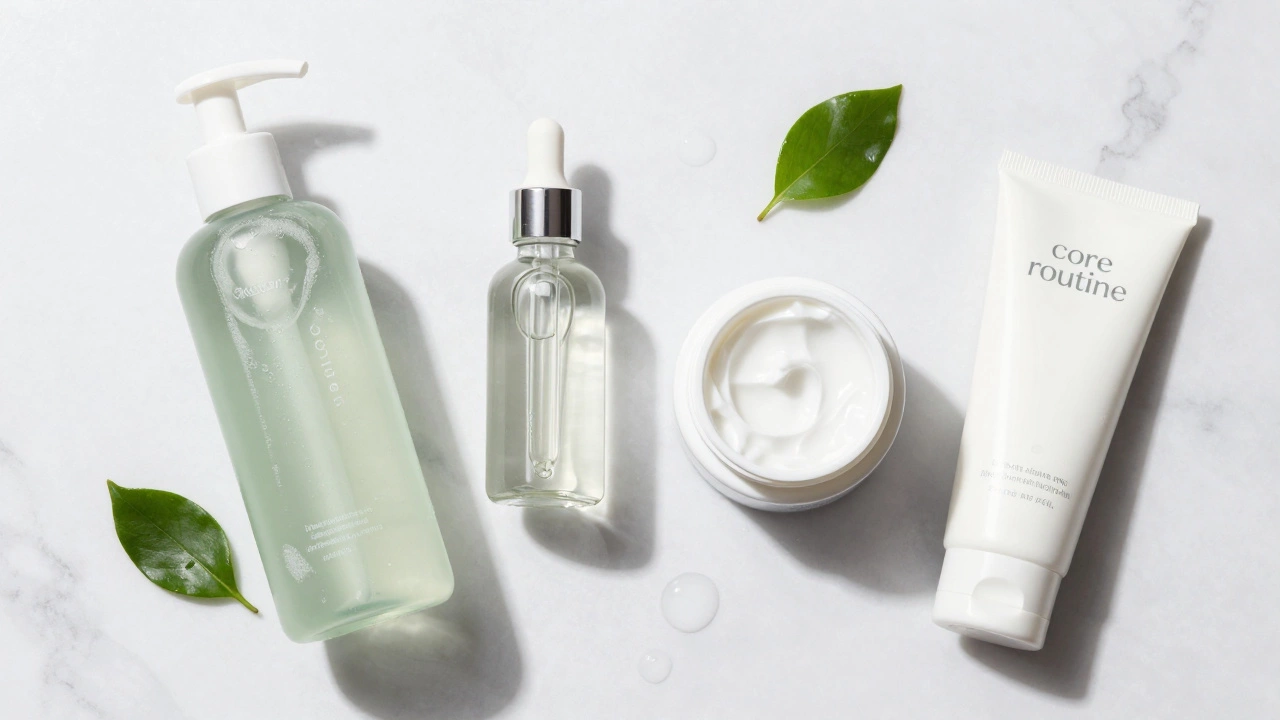
Regardless of your type, every effective skincare routine follows a basic logic: remove the bad stuff, add the good stuff, and seal it all in. You don't need twelve serums. In fact, using too many actives at once can trigger contact dermatitis or a damaged skin barrier, making your skin more reactive than when you started.
The foundation starts with a Facial Cleanser. This is a surfactant-based product designed to remove dirt, makeup, and excess oil without stripping the skin's natural lipids. If you have dry skin, look for non-foaming creams. For oily skin, a foaming gel often works best to cut through the grease.
Next comes the treatment phase. This is where you use Active Ingredients. These are biologically active compounds like vitamins or acids that target specific concerns such as wrinkles or pigmentation. Whether it's a vitamin C serum in the morning or a retinoid at night, this step is where the "heavy lifting" happens.
Finally, you need to moisturize and protect. A Moisturizer is a cream or lotion that hydrates the skin and prevents transepidermal water loss. In the morning, this is followed by a Sunscreen. UV rays are the primary cause of premature aging and skin cancer. If you skip SPF, the rest of your routine is basically a waste of time.
Customizing for Oily and Acne-Prone Skin
If you feel like your face is a grease trap by noon, your goal is balance, not total elimination. If you strip all the oil away with harsh alcohols, your skin will panic and produce more oil to compensate. This is called reactive seborrhea.
Focus on Salicylic Acid (a BHA). Unlike AHAs, BHA is oil-soluble, meaning it can dive deep into the pore to dissolve the "glue" holding dead skin and oil together. Using a 2% BHA liquid two or three times a week can drastically reduce blackheads. Pair this with a lightweight, oil-free moisturizer. Look for "non-comedogenic" on the label-this is just a fancy way of saying it won't clog your pores.
Strategies for Dry and Dehydrated Skin
Dry skin is a skin type (lack of oil), but dehydrated skin is a condition (lack of water). You could have oily skin and still be dehydrated. If your skin looks dull and shows fine lines when you smile, you need humectants.
The gold standard here is Hyaluronic Acid. It's a sugar molecule that can hold up to 1,000 times its weight in water. Pro tip: always apply it to damp skin. If you put it on a bone-dry face in a dry room, it can actually pull water out of your skin, leaving you drier than before. Follow it up with a thick cream containing ceramides to lock that moisture in.
Handling Sensitive and Reactive Skin
Sensitive skin isn't just about redness; it's about a compromised skin barrier. When your barrier is "leaky," irritants get in and moisture gets out. This leads to that stinging sensation when you apply a basic lotion.
The rule for sensitive skin is "less is more." Avoid fragrance, essential oils, and high concentrations of acids. Look for ingredients like colloidal oatmeal or centella asiatica to soothe inflammation. Instead of a physical scrub with jagged beads, use a very mild chemical exfoliant or just stick to a soft microfiber cloth for cleaning.
| Skin Type | Primary Goal | Key Ingredient | Texture Preference |
|---|---|---|---|
| Oily | Oil Control | Salicylic Acid | Gels / Light Lotions |
| Dry | Hydration | Hyaluronic Acid | Rich Creams / Oils |
| Combination | Zonal Balance | Niacinamide | Mixed (Gel/Cream) |
| Sensitive | Soothing | Centella / Oatmeal | Fragrance-free Creams |

Advanced Steps: Exfoliation and Retinoids
Once you have your basics down, you can introduce Chemical Exfoliants. These are acids that dissolve the bonds between dead skin cells to reveal a smoother surface. There are two main types: AHAs (like Glycolic or Lactic acid) which work on the surface to brighten, and BHAs (Salicylic acid) which clean inside the pores. Never use both on the same night unless the product is specifically formulated as a blend, or you'll likely end up with a chemical burn.
Then there's the "gold standard" of anti-aging: Retinoids. Whether it's prescription Tretinoin or over-the-counter Retinol, these derivatives of Vitamin A speed up cell turnover. They are powerful but temperamental. Start slowly-twice a week-and only use them at night, as they make your skin much more sensitive to the sun. If you wake up with peeling skin, you're using it too often. Ease back and focus on hydration.
The Pitfalls of "Over-Skin-Caring"
It's easy to fall into the trap of the 10-step routine seen on social media. But for most people, this is overkill. Over-exfoliating is a common mistake. When you strip away too many layers of skin, you destroy the acid mantle-the thin, slightly acidic film on your skin's surface that keeps bacteria out. Signs of a broken barrier include stinging when applying moisturizer, sudden breakouts in areas you usually don't get them, and a weird, waxy shine that isn't oil.
If this happens, stop all actives. No acids, no retinoids, no Vitamin C. Go back to a basic cleanser and a thick moisturizer for two weeks. Let your skin heal itself before you try to "fix" it with more products.
How long does it take to see results from a new routine?
Skin cells take about 28 to 40 days to turn over. While a moisturizer will make your skin feel softer instantly, active treatments for acne or wrinkles usually take 6 to 12 weeks of consistent use before you see a real difference. Patience is key; don't swap products every week.
Can I use Vitamin C and Retinol together?
Generally, no. Vitamin C is best used in the morning to protect against pollution and UV damage. Retinol works best at night. Using them together can cause irritation and potentially neutralize the effectiveness of both ingredients. Keep them in separate halves of the day.
Do I really need a separate eye cream?
Not necessarily. Most eye creams are just more expensive, gentler versions of your face moisturizer. If your regular moisturizer doesn't irritate your eyes, you can just use that. However, if you need specific ingredients for dark circles (like caffeine) or intense hydration for thin skin, a dedicated eye cream is helpful.
What is the best order to apply products?
The general rule is thinnest to thickest. Start with your water-based cleansers, then toners, then serums (like Hyaluronic Acid or Vitamin C), followed by heavier creams or lotions, and finish with oils or sunscreen. This ensures the lightweight ingredients can penetrate the skin before the heavy barriers seal them in.
Is double cleansing necessary?
If you wear waterproof makeup or heavy sunscreen, yes. An oil-based cleanser breaks down those stubborn products, and a second water-based cleanser removes the remaining residue and cleans the skin. If you're just wearing a light moisturizer and not much else, a single cleanse is usually plenty.
Next Steps for Your Skin Journey
If you're just starting out, don't buy a whole set. Pick one cleanser and one moisturizer. Use them for two weeks. Once your skin is happy, add one active ingredient-like a sunscreen or a gentle exfoliant. If you react badly, you'll know exactly which product caused the problem.
For those with severe cystic acne or sudden adult breakouts, a routine might not be enough. In these cases, a dermatologist can provide prescription-strength treatments like adapalene or oral medications that a store-bought serum simply can't match. When in doubt, professional advice beats a viral TikTok trend every time.