Work-Life Energy Tracker
Track Your Energy & Connection
Rate your energy and connection levels daily to identify patterns and optimize your work-life balance.
Your Weekly Insights
Pattern analysis will appear here after 3+ entries
Let’s be real-most of us think work-life balance is something we’ll get to someday. But someday never comes unless you build it. By 2026, the idea of working 50-hour weeks just to prove you’re dedicated is outdated. People are burning out faster than ever, and companies are finally starting to notice. The question isn’t whether you can balance work and life-it’s how you prioritize it so it actually sticks.
Stop thinking of it as a balance-it’s a scale
Balance sounds like a seesaw. One side work, one side life. If you lean too far left, you crash. But real life doesn’t work that way. Some weeks, work demands 70% of your energy. Other weeks, your kid’s sick, or you’re moving houses, or your aging parent needs help. That’s when you shift the scale. You don’t need equal time. You need intentional time.
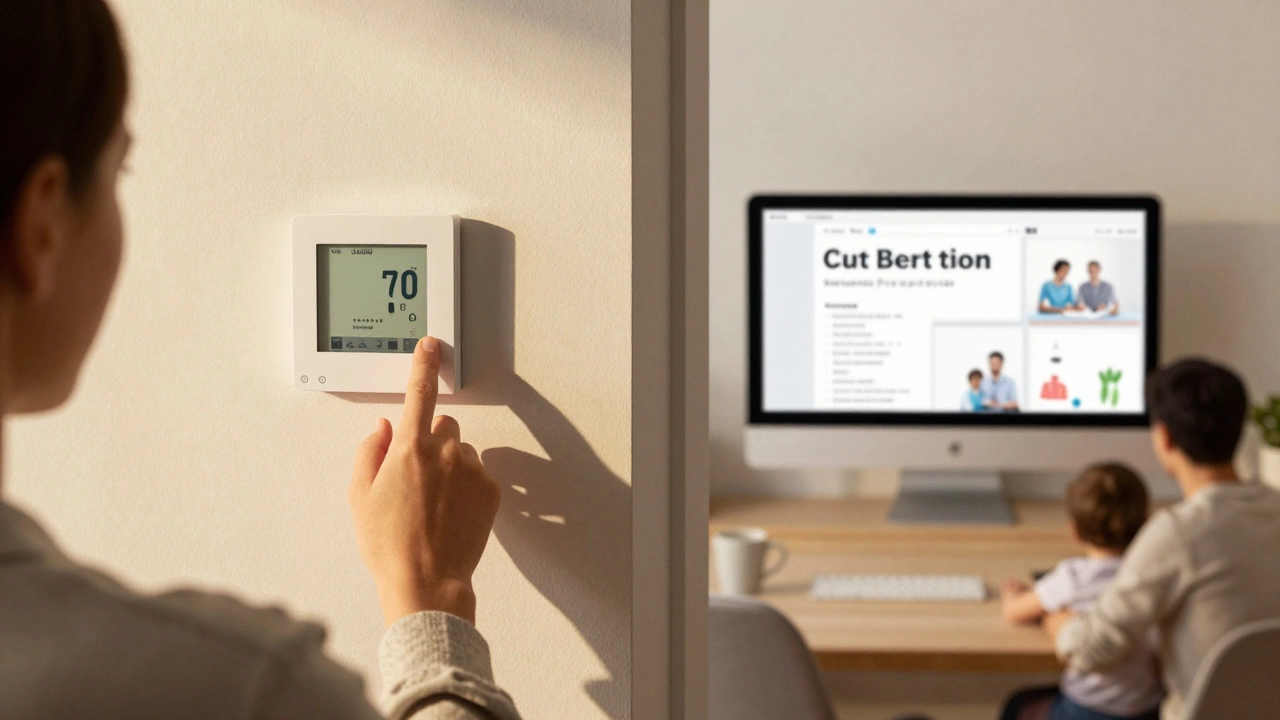
Think of it like a thermostat. You don’t set it to 72°F and forget it. You adjust it based on season, mood, and need. Your work-life scale works the same. On Monday, you might need to protect your 6 p.m. walk. On Friday, you might stay late to finish a project. That’s fine-as long as you’re making the choice, not letting chaos make it for you.
Start with your non-negotiables
What’s the one thing you’d never skip if you had to choose? For me, it’s sleep. Not the 6 hours I scrape by on. I mean 7.5 hours, minimum. I used to think I was a night owl who didn’t need much sleep. Then I started making stupid mistakes at work. Missed deadlines. Forgot meetings. Got snappy with my partner. That’s when I realized: sleep isn’t a luxury. It’s the foundation.
Make a list of your three non-negotiables. They don’t have to be big. Maybe it’s:
- Not checking emails after 8 p.m.
- One hour of quiet time before bed
- Friday lunch with a friend, no matter what
Write them down. Put them on your fridge. Set a phone reminder. These aren’t goals. They’re rules. And once you protect them, everything else becomes easier to manage.
Boundaries aren’t rude-they’re necessary
I used to say yes to every extra task. “I’ll just do it quickly,” I’d tell myself. But “quickly” turned into “all night.” And then I’d feel guilty for not being home. Then I’d resent the job. Then I’d quit.
Here’s what changed: I started saying, “I can’t take this on right now,” without apologizing. Not “I’m swamped,” not “I’ll try.” Just, “I can’t.” And guess what? The world didn’t end. My boss didn’t fire me. In fact, they started asking me what I could take on-because I’d become someone who delivered on promises.
Boundaries aren’t about saying no to work. They’re about saying yes to your well-being. If you’re constantly available, you’re training people to treat your time like a public utility. Set clear hours. Turn off notifications after work. Block lunch on your calendar. And stick to it.
Track your energy, not just your hours
Most people measure work-life balance by time: “I worked 40 hours this week, and I spent 10 hours with my family.” But time doesn’t tell the whole story. What matters is energy.
Did you leave work feeling drained? Or did you leave feeling accomplished? Did you spend time with your partner and feel connected-or just physically present while scrolling on your phone?
I started keeping a simple log for two weeks:
- Rate your energy at the end of each workday (1-10)
- Rate your connection with loved ones after each interaction (1-10)
- Write one sentence about what caused the high or low
After seven days, I saw a pattern: I felt terrible after back-to-back Zoom calls. I felt amazing after walking in the park with my dog. I felt empty after replying to 20 emails in bed. That’s when I redesigned my week. I grouped calls into two blocks. I moved my dog walk to 6:30 a.m. I stopped checking email after 8 p.m.
Energy tracking doesn’t require an app. Just a notebook. But it reveals what really matters.
Design your week-not your day
Day-to-day planning is exhausting. You wake up, make a to-do list, get distracted, feel guilty, repeat. It’s a hamster wheel.
Instead, design your week on Sunday night. Not with tasks. With themes.
Here’s what mine looks like:
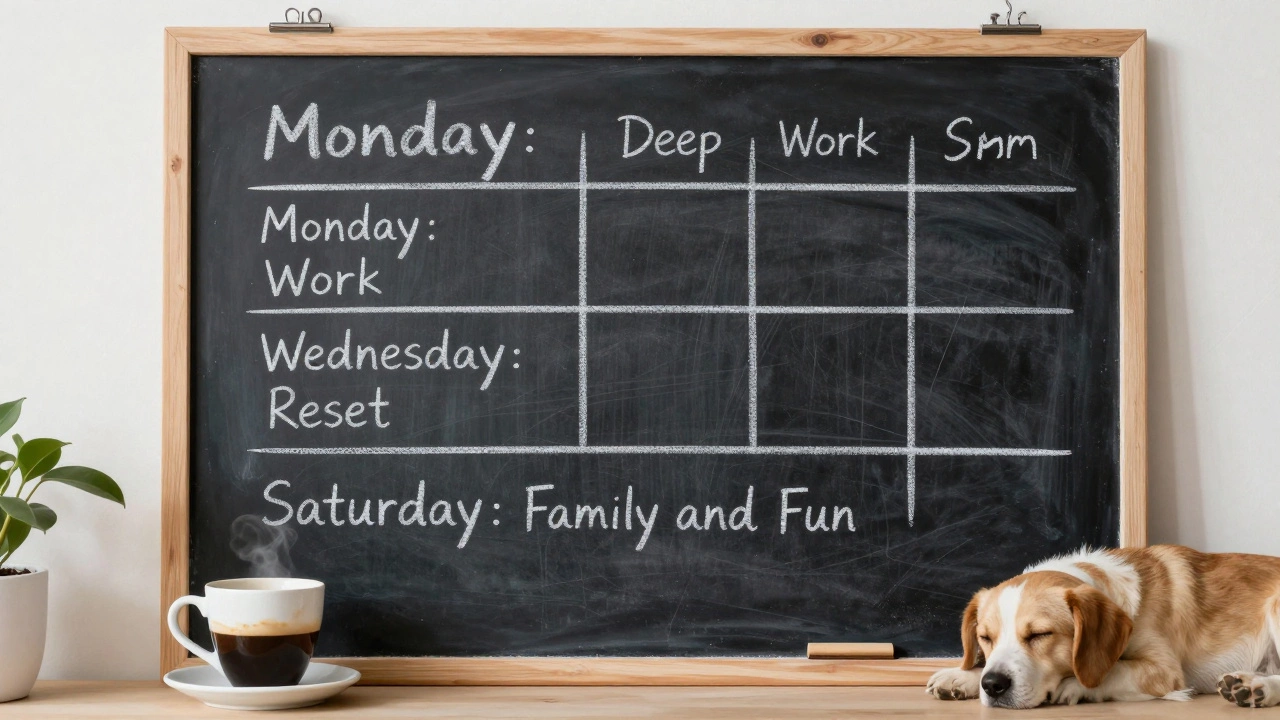
- Monday: Deep work. No meetings. Just writing, planning, coding.
- Tuesday: People day. Meetings, calls, team check-ins.
- Wednesday: Reset. Half-day. Walk, call a friend, no screens after 6 p.m.
- Thursday: Creative time. Art, music, journaling-anything that sparks joy.
- Friday: Wrap-up. Clean up emails, plan next week, leave by 4 p.m.
- Saturday: Family and fun. No work talk.
- Sunday: Prep and rest. Meal prep, laundry, early bed.
This isn’t about being rigid. It’s about creating rhythm. When you know Wednesday is your reset day, you don’t feel guilty for saying no to a last-minute meeting. You know you’ve got space built in.

Reclaim your transitions
Most people skip the moments between work and life. You log off, then immediately scroll TikTok. You leave the office, then hop into the car and start planning dinner. You never actually arrive.
Transitions matter. They’re your mental reset button.
I started building 10-minute rituals between work and home:
- Walking to my car with no headphones
- Standing in the driveway for 60 seconds, breathing
- Changing clothes before I say hello to my partner
It sounds silly. But those 10 minutes let my brain shift from “work mode” to “human mode.” No phone. No noise. Just me.
Try it. Even if it’s just stepping outside and feeling the air. You’re not wasting time. You’re reclaiming it.
It’s not about doing more-it’s about protecting what matters
Work-life balance isn’t about squeezing in yoga, meditation, and family dinners between deadlines. It’s about realizing you don’t have to do everything. You just have to protect what you can’t live without.
That might be your sleep. Your dog. Your Sunday coffee with your sibling. Your right to say no. Your ability to feel tired without guilt.
Start small. Pick one non-negotiable. Protect it for a week. Then add another. Don’t wait for the perfect time. There is no perfect time. There’s only now.
You don’t need more hours. You need clearer boundaries. Better energy awareness. And the courage to treat your life like it matters-even when the inbox is full.
What if my job doesn’t allow me to set boundaries?
If your job expects you to be always available, you’re not alone. But even in high-pressure roles, small shifts work. Start by protecting one hour a day-like lunch or the first 30 minutes after you get home. Use that time to reset, not respond. If your manager pushes back, say, “I’m more productive when I’m rested. I’m happy to deliver results, but I need space to recharge.” Most managers respect results more than hours. If they don’t? That’s a sign the job doesn’t value you as a person.
Can work-life balance improve my physical health?
Absolutely. Chronic overwork is linked to higher blood pressure, weakened immune function, and increased risk of heart disease. A 2024 study from the University of Melbourne tracked 1,200 professionals over 18 months. Those who consistently protected 7+ hours of sleep and took at least one full day off per week saw a 32% drop in stress-related illnesses. It’s not magic-it’s biology. Your body doesn’t work on “hustle mode.” It needs rest, movement, and connection to stay healthy.
What if I feel guilty when I’m not working?
Guilt is a habit, not a truth. It’s been trained into you by a culture that equates busyness with worth. Start noticing when guilt shows up. Ask yourself: “Am I resting because I’m lazy-or because I need to?” If you’re sleeping, walking, laughing, or reading for pleasure, you’re not wasting time. You’re refueling. Try this: every time you feel guilty, say aloud, “I am allowed to rest.” Say it three times. It feels weird at first. Then it starts to stick.
How long does it take to see results from better work-life balance?
You’ll notice small changes in 7 days-better sleep, less irritability, more focus. Real transformation takes 6-8 weeks. That’s how long it takes to rewire habits and reset your nervous system. Don’t expect overnight miracles. Do expect steady progress. If you protect your non-negotiables for six weeks, you’ll start to feel like yourself again. Not the tired, overwhelmed version. The one who shows up fully-in work and in life.
Is work-life balance different for remote workers?
Yes-and it’s harder. Without a commute, the line between work and home disappears. You might work from the couch. Answer emails during dinner. Skip lunch because you’re “in the zone.” Remote work demands even more intentionality. Create physical separation: a dedicated workspace, even if it’s just a corner of the kitchen. Use visual cues: turn off your work laptop after hours. Put on different clothes. These small rituals tell your brain: “Work is done.”
If you’re reading this, you’re already on the path. You didn’t just scroll past. You paused. That’s the first step. Now, protect one thing today. Not tomorrow. Today.